What is Carnivore Score?
Carnivore Score in Insights describes the animal-food share of the calories in your recorded foods. It is a view of what you logged, not a measure of your health, a nutrition target, or a judgment about your day.
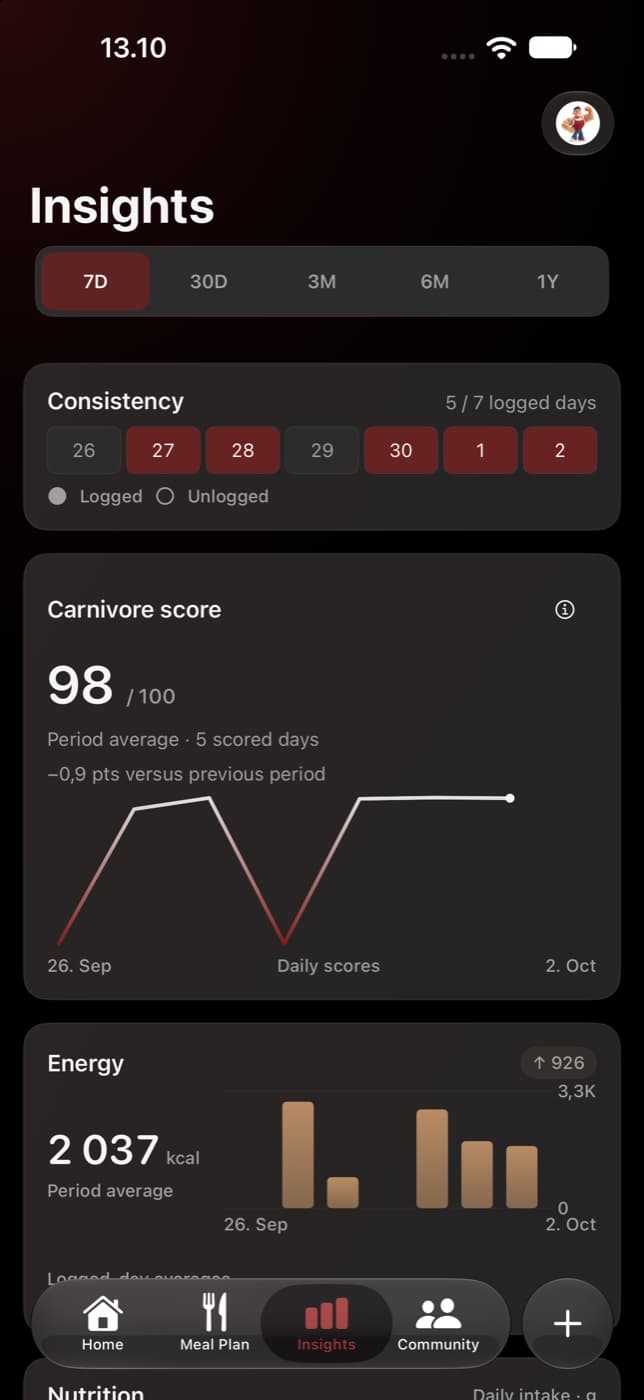
Start with the score in Insights
Open Insights and select a range such as 7D or 30D. The Carnivore Score card shows a period average and the number of scored days. Open its details or information view to see the available explanation and recorded-day information.
How the score is calculated
For each day, Carnivor classifies the logged food items as animal or non-animal and uses their recorded calories. The daily calculation is animal-food calories divided by total classified food calories, multiplied by 100. The result is bounded between 0 and 100 and rounded to one decimal place.
| Recorded calories | Contribution |
|---|---|
| Animal foods | Included in both animal calories and total classified calories. |
| Non-animal foods | Included in total classified calories, but not animal calories. |
| Unclassified or mixed foods with positive calories | Can make the whole day’s score unavailable. |
| Items with zero, negative, or unusable calorie values | Skipped by the score calculation. |
For example, a day with 900 recorded animal-food calories and 100 recorded non-animal calories has a score of 90. This is a calorie share, not the percentage of food items or grams that were animal foods.
Recognized animal foods include meat, fish, eggs, animal fats, and dairy. Food names matter: an explicitly plant-based substitute is not classified as an animal food just because its name contains “milk” or “butter.” A mixed dish may need separate ingredients before Carnivor can determine its animal calorie share.
What contributes—and what does not
The recorded foods and their calories determine this score. Fasting duration, exercise, steps, logging streaks, and protein or carbohydrate targets do not add points to the Insights calculation. Protein, fat, and carbs remain useful nutrition context, but they are not separate penalties or bonuses here.
A higher score means a higher animal-food calorie share among the classifiable foods you recorded. It does not establish that your total intake was adequate, that the day was fully logged, or that a particular diet is right for you.
Missing logs are different from a zero
No logged items means no daily score. A day can also be unavailable if it contains an unrecognized or mixed positive-calorie item, or has no usable positive item calories. Carnivor does not replace an unavailable score with a real zero when calculating the period average.
A genuine zero can occur when all usable, classifiable food calories on a recorded day are non-animal. This is different from an unlogged day.
How historical averages work
The period average is the mean of the available daily scores. Each scored day has equal weight; Carnivor does not pool every calorie in the whole period and calculate one ratio. If two scored days are 100 and 80, their average is 90 even if the days have different calorie totals.
A partially logged day can have a score, including today. The score only describes the foods recorded so far. Previous-period comparisons use matching completed-day spans and exclude today, so the comparison is not necessarily a subtraction of the headline averages.
Historical scores are recalculated from logged items. Correcting a food or changing its calories can change that day and the period average. Changes to food classification can also affect history. If scoring versions cannot be compared reliably, a comparison may be unavailable.
Use the score alongside your logging context
- Choose a range long enough to include several recorded days.
- Check how many days actually have a score, then review logging consistency separately.
- If a number looks unexpected, inspect the foods and portions you recorded before drawing a conclusion.
- Compare patterns over time rather than trying to optimize one incomplete day.